Salary Transparency Platform
Improving salary transparency for millions of job seekers by transforming inconsistent job data into reliable salary estimates.
The challenge
Job seekers were making career decisions based on salary estimates they couldn't fully trust.
Behind the scenes, job postings arrived with inconsistent or incomplete structured data — role titles that meant different things across employers, missing seniority levels, conflicting location mappings, and gaps in core attributes. The salary model was being fed sparse, noisy inputs, so the estimates it produced felt wrong to users and eroded trust in the marketplace.
My work focused on improving taxonomy, structured data and data quality so salary estimates became more reliable and trustworthy.
- —Three legacy ingestion systems
- —No additional engineering headcount
- —Zero disruption during rollout
Discovery
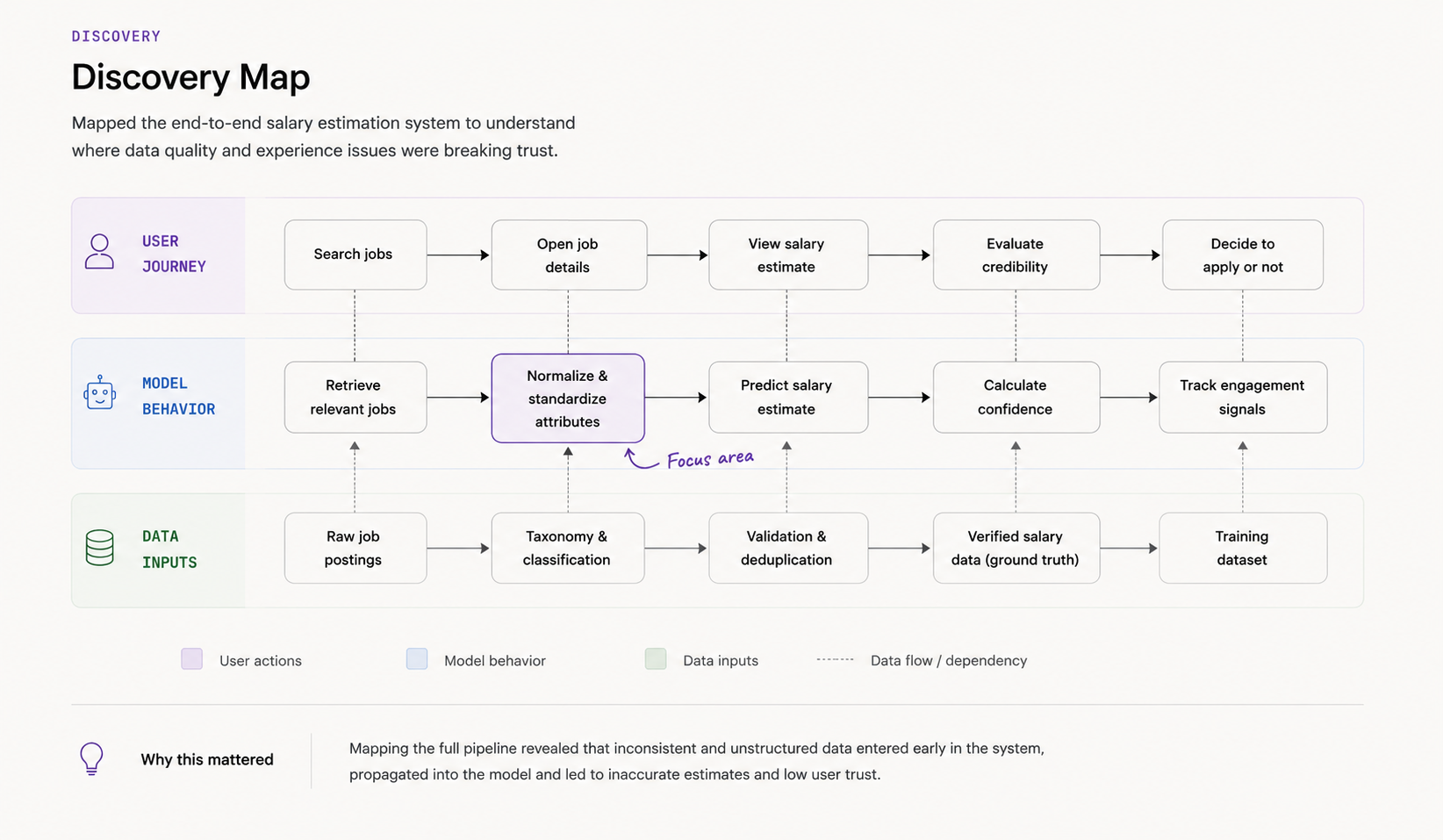
To understand where trust was breaking down, I focused on understanding both the data and the user experience.
- —Mapped every field feeding the salary estimation pipeline
- —Interviewed job seekers to understand which estimates felt credible and why
- —Audited employer posting flows to identify where structured data was being lost
- —Traced data lineage from ingestion through to the salary estimation model
Key decisions
Treat structured data as the product
Rather than treating taxonomy as backend infrastructure, we treated structured data as part of the user experience because it directly shaped the salary estimates users saw.
Standardize before optimizing
Built a unified taxonomy before improving the salary model itself, so every later gain compounded on a stable foundation.
Make uncertainty visible
Used confidence scoring so users could understand when estimates were reliable, instead of hiding uncertainty behind a single number.
Solution
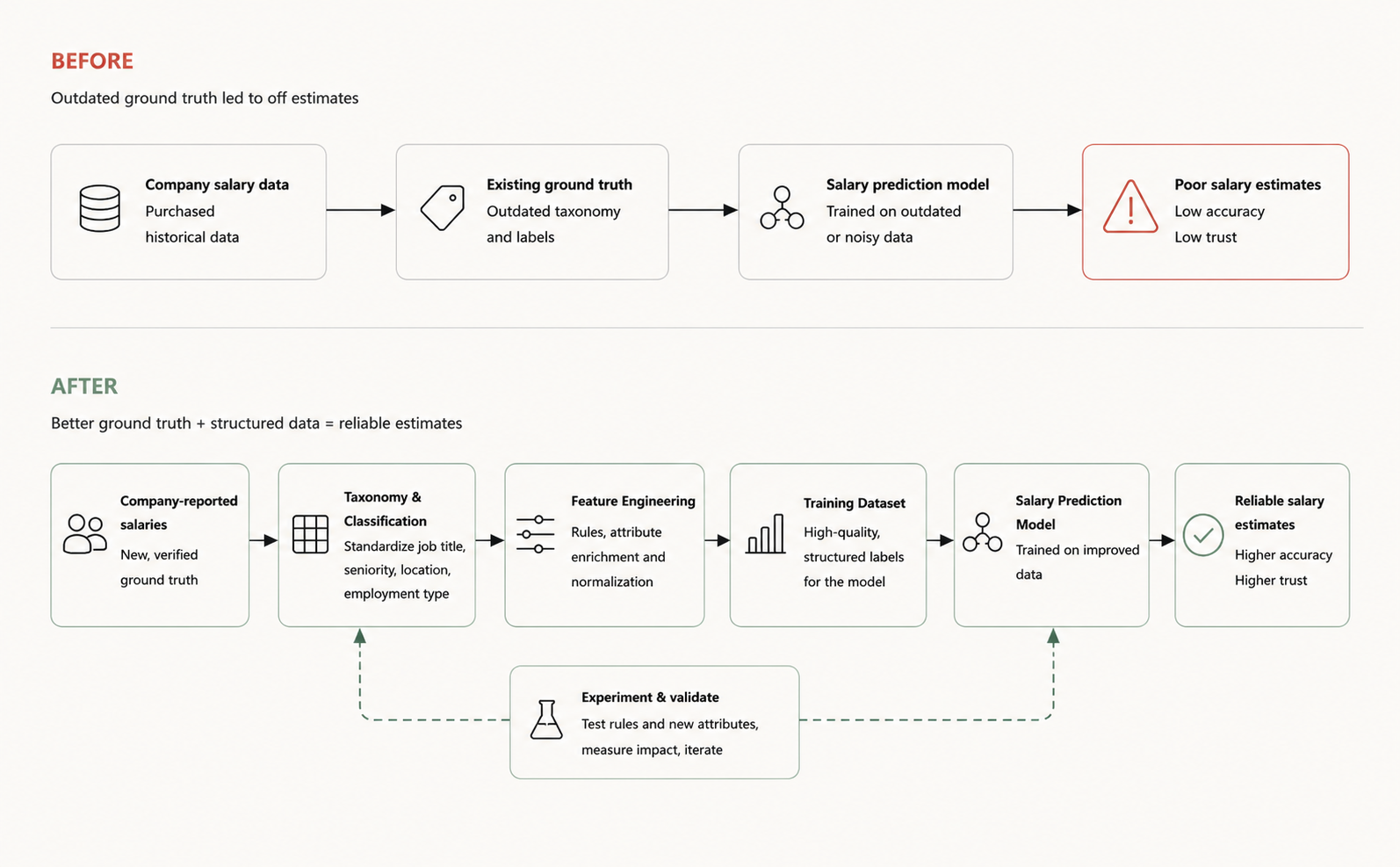
We improved the model by improving its inputs.
Rather than tuning salary predictions directly, we rebuilt the training pipeline using verified salary data, structured taxonomy and continuous experimentation. Better inputs produced more reliable salary estimates and increased user trust.
Unified job taxonomy
Mapped job titles, seniority, locations and employment types into canonical values so similar jobs could be compared consistently across employers.
Improve model inputs
Introduced structured rules and validated new attributes against verified salary data to improve the quality of the model's training dataset.
Make confidence visible
Displayed confidence indicators alongside salary estimates so users could better judge when an estimate was reliable.
Results
Improving structured data increased both the accuracy and coverage of salary estimates, making salary information more trustworthy for millions of job seekers while increasing marketplace engagement.
Working together
Gerta consistently guided our data-driven projects with a keen eye for outcomes. Her ability to analyze and apply data insights was a key contributor to our team's achievements.
Her technical background, coupled with a keen understanding of the product landscape, brought a unique perspective to our team. Gerta consistently leveraged this dual skill set to drive innovative solutions and make informed decisions.
Gerta brings clarity, asks thoughtful questions, and keeps everyone aligned around product goals and user needs. Working with her was truly a pleasure.